Jason Longmate — Treatment in India
Jason Longmate, 52, was diagnosed with an inoperable glioblastoma in October 2025. From February to May 2026, he underwent treatment in India.
I meet Jason and his wife Ellen over Zoom from their home in Nottinghamshire, on a rainy June morning. Their story starts all too familiarly. After experiencing sudden problems with one eye, Jason was referred to a stroke clinic, where, devastatingly, he found out he had a brain tumour. Heart-stopping news in any circumstances, it was the way in which it was delivered that has stayed with them most vividly: ‘the good news is you have a brain. The bad news is you’ve got a brain tumour.’
‘It was very, very insensitive’, says Ellen. Shockingly, more was to follow—post-biopsy, as they reeled from the diagnosis of an inoperable glioblastoma (stage four brain cancer), a doctor joked that at least the loss of Jason’s driving licence meant Ellen could now do the pub run. Little wonder then, that they were already losing faith in the system. Later, reflecting back, Jason comments that such remarks, however they are intended, ‘erode the trust between the patient and clinicians’, in a situation where professionalism and respect for the family at the centre, should trump all else. I share my own father’s experience of malpractice at the point of diagnosis, and we talk about the disappointing prevalence of this in our community. The changes needed, Jason explains, are simple and easy to remedy—sensitivity, privacy, an openness to respond to patient questions, and the presence of the right people for the task, trained in delivering difficult news.
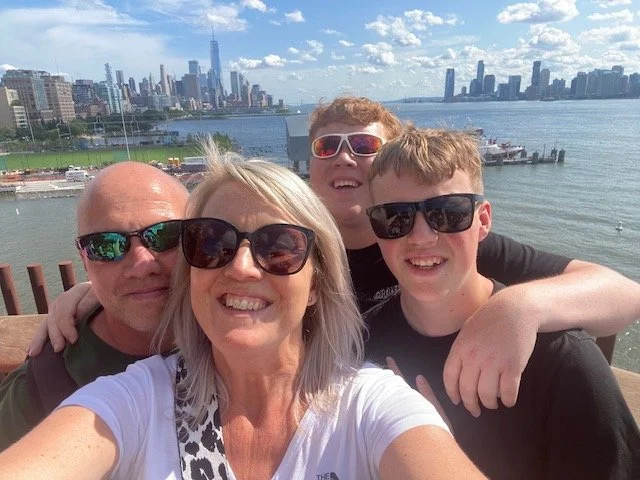
From left: Jason, Ellen, Austin (22) and Jenson (19)
After a tough period of uncertainty, it was confirmed that Jason would receive the standard UK treatment of radiotherapy and chemotherapy. But understanding the gravity of the situation, the couple, parents to Austin, 22, and Jenson,19, had already taken matters into their own hands. It is something they attribute in part to life experience—Jason is a former army officer, and as a family they are used to adaptation, with Ellen putting her own tenacity down to her experiences as a military wife (she now works for the police). Faced with a devastating prognosis, and those same, crude treatments that have remained stagnant over decades, she describes googling day and night to initiate an immediate regime of repurposed drugs and supplements, and research every line of therapy. The couple opted to pursue private oncothermia in London—something that although expensive and time consuming, they credit with offering much needed hope. A further breakthrough seemed to have come when Jason interviewed for a clinical trial at the Royal Marsden, but the offer was retracted the following day when criteria changed. It was a crushing disappointment. And then came talk of ‘The Art of Healing Cancer’ centre in Delhi, which they heard about third-party, through pure coincidence.
It was a curveball. Though, like many people, the couple had looked into treatment in Germany (ultimately deciding against this, as effectiveness was not guaranteed), India was never on the radar. But Elllen had a conversation which changed everything—a local mother with brain cancer had been given a six-month prognosis. After an adverse reaction to both radiotherapy and chemotherapy, she had sought treatment in Delhi, and gone from being wheelchair-bound to walking again, looking after her young children and returning to work. It became an option they felt compelled to explore.
You can sense how surreal it all still feels, even now. Jason and Ellen had never been to India, let alone imagined travelling there for cancer treatment. But after an online meeting with the centre manager, they found themselves hovering over flight bookings. Eventually they ‘hit the button’, from which point things escalated rapidly. The logistics such as travel visas, airport transfers and accommodation were swiftly dealt with from the Indian side, and before they knew it they were in a taxi, travelling through the madness of Delhi. Both laugh as they recall the initial overwhelm of the experience, which even included a minor traffic collision. But any misgivings were soon to be dispelled.
‘The Art of Healing Cancer’ deals with many forms of the disease, but its general approach is holistic, with a wide range of treatments collated on-site, and led by a small, co-ordinated team. There is little that will feel unfamiliar to those travelling from the UK; rather it is the multiplicity of treatment and continuity of care that is unique. Patients are given low dose radiotherapy and chemotherapy (the latter often on a rotating basis, should any type prove ineffective), hyperbaric-oxygen and hydro-inhalation therapy, ECCT, off-label drugs (which in Jason’s case have included anti-malarials), and vitamins administered via IV. Though there is the odd visit to the nearby C.K. Birla Hospital, treatment remains centered around the convenience of the patient, and as localised as possible. IVs and oral medication, for example, can be delivered in the comfort of their personal accommodation. ‘Clinically, I can’t really fault it’, says Jason. Turnaround is also fast—scan results are delivered almost immediately, taking away much of the anxiety that cancer patients feel in the wait for significant news.
The centre has also recently introduced RGCC testing for brain tumours. This involves undergoing a lumbar puncture procedure to extract a spinal fluid biopsy, that can then be analysed to detect the characteristics of rogue cells and the pathways that feed a tumour, and determine the most effective course of treatment. Whilst the RGCC test is used in the UK to assess other cancers (primarily using blood biopsies), it is not recognised as an option for malignant brain tumours. And yet Jason’s case shows its value—though a complicated process, which involved sending samples to Cyprus, the test determined that his type of glioblastoma would be unresponsive to immunotherapy (most commonly sought in Germany). It was a result that gave the couple peace of mind following their decision to pursue a lesser known, comparatively inexpensive path. They urge other families to explore treatment feasibility before making any significant financial commitments.
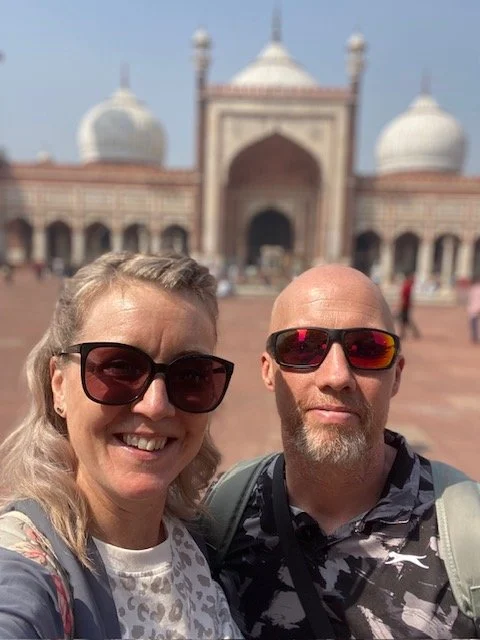
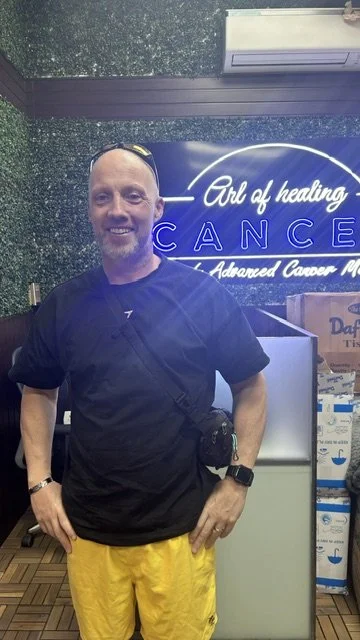
Thankfully, Jason’s treatment in Delhi has led to a reduction in the size of his tumour which, as he comments, is a ‘running theme’—every patient they have met (by now quite a few), has seen an improvement in their condition; clear testament to the clinical expertise of the team. And yet strikingly, it is the ambitious and pro-active attitude seen in Delhi, which seems to have made the biggest impact on the couple. Whereas in England they encounter repeated apathy, the Indian team meet their energy like for like. ‘They will throw the kitchen sink at it’, says Ellen of the doctors. Patient involvement and self-advocacy is encouraged, and they are part of an ongoing WhatsApp group where questions are welcomed and responded to in a timely manner. Whereas in England the ‘right to try’ remains a distant concept, and the latest figures show that less than 40% of brain cancer patients are made aware of clinical trials, let alone enrolled in them, in India treatment suggestions are keenly explored. ‘It is never the end of the road’ says Jason. The young mother they first heard of with a six-month prognosis, will soon be returning to the Centre to undergo RGCC testing, which was unavailable during her previous stay: the aim now, the doctors say, is to ensure long-term stability.
This contrast in attitude has been thrown into sharp relief by Jason and Ellen’s recent experiences in this country, where they encounter continued inaction. They have received non-committal responses to all suggestions of clinical trials, and to Jason’s request to be involved in the NHS’s ‘Cancer Vaccine Launchpad’. The couple also requested a referral to a nearby cancer centre—four months later (six by the time of publication), they are still waiting for news on this. It is a galling situation, particularly given that time is of the essence to any glioblastoma patient. ‘I just wonder where, or how, did we get to the point where we give up on people, when we should be trying everything [...] what drives this decision in the NHS world?’, asks Jason. Poignant words indeed, which will resonate with many patients and families across our community.
So what now for the Longmate family? Jason will likely return to India, and remains in touch with the clinicians there, continuing the treatments advised by them wherever possible. Ellen is now trained in administering IVs, meaning that Jason can have his supplements, such as Vitamin C infusions, in the comfort of his own home. The criteria are strict for this, and it is important to note that anyone doing IVs for a non-family member must be CQC registered. However, it is an approach that, when possible, can save significant time and money. Jason is also on a trial medication, Valganclovir, which he accesses through Dickson’s Chemist in Glasgow, who offer oncological support. It is possible to obtain Valganclovir elsewhere, but the prescription is cheaper in Scotland.
Of course, all such treatment comes at a significant cost, and this is something that looms large. Jason and Ellen are open about the challenges—not only have they had to use savings, but Jason, who continues to work for the Army, anticipates that he will soon be medically discharged, putting further strain on the family finances. Though they have an ongoing crowdfunder, this was something that was set up reluctantly, and requires time and effort in an already extremely difficult situation. As we discuss, the practice has, of necessity, become all too common—it is hard to accept that those who have paid diligently into the National Health Service, are being failed to such a point.
In the meantime, the Longmates document their experiences on Instagram, under the handle ‘holdthelinejason’. Their aim, they explain, is to make people aware of the options available to them, and to offer that all important element of hope. A close-knit family who hold each other up, they are keenly aware of patients who may be isolated, or who lack the resources to self-advocate. At the same time, they firmly believe that it is only those at the centre of this devastation who will drive change. As Ellen says: ‘People are (becoming) more educated. They’re not prepared to go into those rooms and be broken [...] we know that the NHS is not fit for purpose. We’ve known that for a long time now, since Covid. We want more, and we’re not prepared to be pushed away.’
No doubt, this inspiring couple have already given hope to many in our community. We at Brain Cancer Justice are deeply grateful to the Longmates for sharing their experience, and wish Jason every success with his continued treatment.
An update since the interview: We are delighted to share that Jason’s latest MRI, with results delivered in early July, showed further shrinkage of his tumour. The couple have been advised by their oncologist to continue everything they are doing.
They recently made the most of this breathing space with a well-deserved break in Menorca, where they ‘simply (enjoyed) being Jay and Ellen again’.
By Amy Parsons, Brain Cancer Justice Patient Communications Volunteer
Disclaimer- Brain Cancer Justice has no affiliation with ‘The Art of Healing Cancer’, and encourages patients and families to explore options rigorously before committing, wherever treatments are based.
